

Reading the Quran in Arabic without understanding what it means is a strange experience. You can feel the weight of the language, the rhythm of the recitation, and even the emotional pull of it, and still walk away without knowing what a single verse is actually telling you to do. That gap between reciting and understanding is exactly what tafseer exists to close.
If you’ve typed “Quran with tafseer” into a search bar, you’re probably trying to solve one of two problems: either you want to actually understand what you’re reading instead of just pronouncing it correctly, or you’ve hit a verse that confused you and you want to know what scholars say it means. This guide covers both what tafseer is and which tafseer works are worth your time, how to actually study with one, and the mistakes that trip up almost everyone who starts.
What Does “Quran with Tafseer” Actually Mean?
Tafseer (تفسير) comes from an Arabic root meaning “to explain” or “to unveil.” In practical terms, it’s the body of scholarly commentary written to explain what a Quranic verse means, its linguistic meaning, the historical context it was revealed in, how it connects to other verses, and how classical scholars understood its legal or spiritual implications.
“Quran with tafseer” simply refers to a copy of the Quran, whether a physical book, an app, or a website, that includes this explanatory commentary alongside the Arabic text and its translation. Instead of just reading “And establish prayer,” you get the verse, its translation, and then a paragraph or more explaining when it was revealed, what “establish” implies beyond just performing the motions, and how early scholars understood the command.
This matters because the Quran wasn’t written as a plain instruction manual. It uses legal language, poetic language, historical references, and responses to specific events in 7th-century Arabia. Without context, a reader can easily misread a verse’s intent, which is precisely why tafseer became one of the earliest and most rigorous branches of Islamic scholarship.
Why You Shouldn’t Just Read a Translation Alone
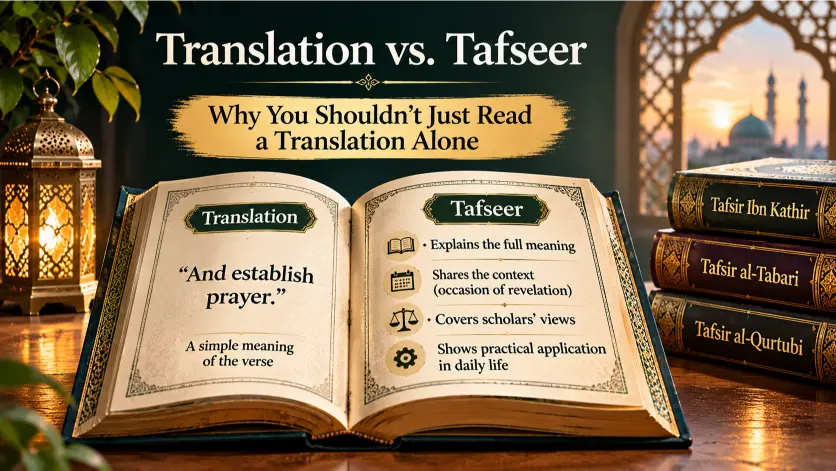
Translation and tafseer solve different problems. A translation converts words from Arabic into another language. Tafseer explains meaning, context, and application, things a direct translation often cannot carry over.
Here’s a simple example of why this gap matters: Arabic words frequently carry several layered meanings that don’t map onto a single English word. A translator has to pick one meaning and commit to it, which means nuance gets lost. Tafseer restores that nuance by discussing the range of meanings scholars have debated for a given word or phrase.
There’s also the matter of asbab al-nuzul, the “occasions of revelation.” Many verses were revealed in response to a specific event: a question someone asked the Prophet, a conflict in the early Muslim community, or a social practice that needed correcting. Knowing that context changes how a verse should be understood. A verse addressing a specific wartime situation, for instance, isn’t meant to be read as a universal, context-free command, and tafseer is where you learn which category a verse falls into.
The Major Tafseer Works You’ll Actually Encounter

There isn’t one single “official” tafseer. Instead, there’s a long tradition of scholars across centuries, each bringing their own methodology, depth, and focus. Here are the names that come up constantly once you start looking:
- Tafsir al-Tabari (Jami‘ al-Bayan) — Written by Muhammad ibn Jarir al-Tabari in the 9th–10th century, this is widely regarded as the foundational tafseer. It’s massive, heavily focused on compiling the explanations transmitted from the Prophet’s companions and early scholars, and it’s often the first reference other commentators cite before adding their own analysis.
- Tafsir Ibn Kathir — Probably the most popular tafseer among English-speaking readers today, written by Ibn Kathir in the 14th century. It’s known for explaining the Quran primarily through other verses of the Quran and through hadith (sayings of the Prophet), which gives it a reputation for being relatively conservative and text-grounded rather than speculative.
- Tafsir al-Qurtubi — Known for its strong focus on legal rulings (fiqh) derived from verses, making it a go-to reference for scholars working through Islamic jurisprudence questions.
- Tafsir al-Baghawi — A more concise, accessible classical tafseer that’s often recommended to readers who find al-Tabari too dense.
- Tafhim al-Quran — Written by Abul A‘la Maududi in the 20th century, this is a modern tafseer aimed at a contemporary audience, often discussed in terms of its socio-political and reformist framing.
- Ma‘ariful Quran — Written by Mufti Muhammad Shafi, a 20th-century Hanafi scholar; it’s detailed, legally thorough, and popular in South Asia and among English-reading students for its accessible style.
- Tafsir al-Sa‘di — Known for its brevity and clarity, often recommended to beginners because it avoids excessive digressions into grammar or sectarian debate.
For readers following the Shia tradition, Tafsir al-Mizan by Allama Tabatabai is a major 20th-century work, known for its thematic, Quran-explains-Quran approach and philosophical depth.
None of these is “the” correct tafseer, they represent different eras, methodologies, and sometimes different scholarly emphases. Part of learning to use tafseer well is understanding that disagreement between commentators on a given verse’s finer meaning is normal, not a sign something is wrong.
How to Choose Which Tafseer to Start With
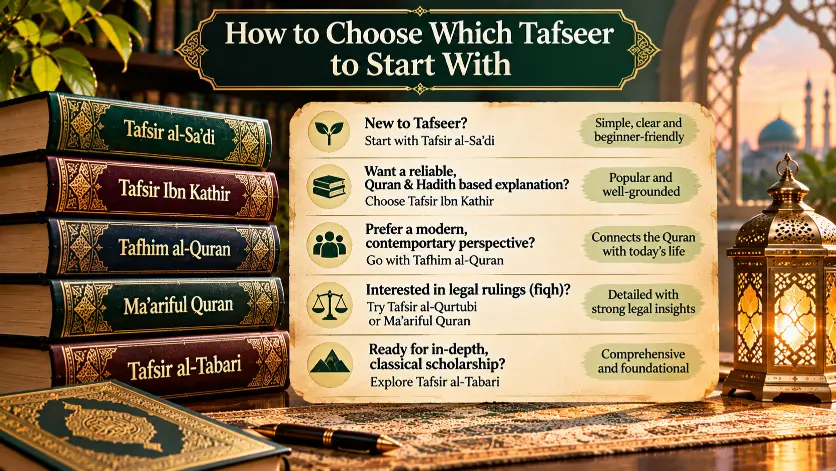
If you’re new to this, don’t start with al-Tabari, it’s extraordinary but dense enough to overwhelm someone just trying to understand a chapter for the first time. A more realistic starting sequence looks like this:
- Complete beginner, reading in English: Start with a translation that includes a brief footnote-style tafseer, such as Abdullah Yusuf Ali’s or Muhammad Taqi Usmani’s translation with notes, or a condensed tafseer like al-Sa‘di’s in translation.
- Want depth without the SOUTH legal detail: Ibn Kathir’s tafseer (translated into English and widely available) is the standard next step.
- Interested in legal/jurisprudential reasoning: Move to al-Qurtubi once you’re comfortable with the basics.
- Want a modern, thematic lens: Tafhim al-Quran or Ma‘ariful Quran, depending on whether you want a reform-oriented or traditional legal framing.
A practical tip: whichever tafseer you choose, check who translated it into your language and when. Older English translations of classical tafseer can read stiffly; more recent translations (many produced in the last 15–20 years by organizations like Darussalam or the International Islamic Publishing House) tend to be more readable.
How to Actually Study the Quran with Tafseer (Step by Step)
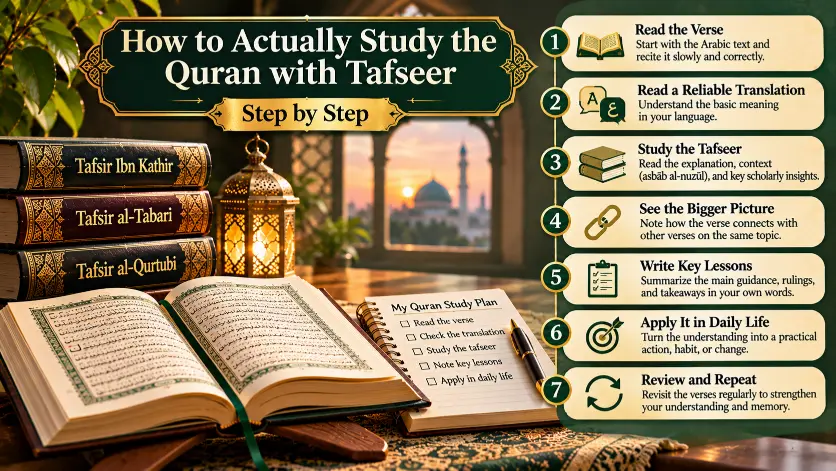
Owning a tafseer and reading one properly are two different habits. Here’s a structure that works for most self-learners:
- Read the Arabic verse first, even if you can’t understand it fully. This keeps you anchored to the actual text rather than only ever engaging with someone’s interpretation of it.
- Read the translation. Get the surface-level meaning before diving into commentary.
- Read the tafseer for that verse or passage. Don’t skip around; tafseer is written assuming you’ve read what came before, since many verses are explained in light of earlier ones.
- Note the occasion of revelation if one is given. This single step prevents more misunderstanding than almost anything else.
- Cross-check with at least one other tafseer on verses that confuse or unsettle you. Reading only one commentator on a difficult verse means you’re getting one scholar’s reasoning without the context of how others understood it.
- Ask a local scholar or imam about anything that still feels unclear. Tafseer is meant to be studied, historically, under guidance, not purely as solo reading. Books are a supplement to teachers, not a replacement for them.
- Revisit short chapters you’ve already studied periodically. Understanding deepens on re-reading far more than it does on a single pass.
Common Mistakes People Make
Treating tafseer as infallible. Tafseer books are scholarship, not revelation. Scholars disagreed with each other constantly, and that disagreement is part of the tradition, not a flaw in it.
Reading only modern tafseer and skipping classical ones (or the reverse). Modern commentaries often address contemporary questions classical scholars never anticipated, but they build on, and sometimes depart from, classical methodology. Reading only one side gives an incomplete picture.
Cherry-picking verses out of sequence. A verse pulled out of its surrounding passage, without the tafseer explaining its context, is one of the most common ways verses get misunderstood or misused, including by people arguing in bad faith online.
Assuming one translation’s footnotes count as “a tafseer.” Many popular English Qurans include brief explanatory notes, which are helpful but are not a substitute for a full tafseer work, they’re usually a condensed summary of one.
Where to Access Quran with Tafseer Today
You don’t need a library of physical books to get started. A few widely used options:
- Quran.com — Offers multiple English tafseer options (including Ibn Kathir and al-Jalalayn) verse by verse, free, with no account needed.
- Altafsir.com — Run by the Royal Aal al-Bayt Institute, this hosts a large library of classical tafseer works in Arabic and some in English, useful once you want to compare multiple commentators side by side.
- Mobile apps such as “Quran Majeed” or “Al Quran (Tafsir & by Word)” bundle recitation, translation, and tafseer into one interface, which is convenient for daily reading.
- Physical multi-volume sets of Ibn Kathir or Ma‘ariful Quran: if you prefer studying without a screen, many readers find retention improves when note-taking happens on paper next to a physical book.
Frequently Asked Questions
Is reading the tafseer necessary, or is reading the Quran’s translation enough?
Translation gives you the surface meaning; tafseer gives you context, linguistic nuance, and the reasoning behind that meaning. For personal reflection, a translation can be a start, but anyone trying to understand verses with legal, historical, or theological weight benefits significantly from tafseer.
Which tafseer is best for beginners?
Most teachers recommend starting with a translation that has condensed explanatory notes, then moving to Ibn Kathir’s tafseer in translation once you want more depth.
Can I study tafseer without an Arabic background?
Yes. Most major tafseer works have been translated into English and other languages, though some nuance around Arabic grammar and wordplay is inevitably harder to convey in translation.
Why do different tafseer books disagree on the same verse?
Scholars across different eras used different methodologies, some leaned heavily on hadith, others on linguistic analysis, others on legal reasoning. Disagreement reflects the diversity of scholarly tools applied, not an error in the text itself.
Is it okay to read tafseer on my own without a teacher?
It’s a reasonable way to start, but classical scholarship strongly encourages studying tafseer under a teacher, especially for verses touching on law, theology, or anything where misreading carries real consequences.
What’s the difference between tafseer and tarjuma?
Tarjuma is translation, converting the words. Tafseer is explanation, unpacking meaning, context, and implication. A tafseer always includes translation implicitly, but a translation alone is not tafseer.
Do Sunni and Shia traditions use different tafseer works?
Yes. Sunni scholarship relies heavily on works like al-Tabari and Ibn Kathir, while Shia scholarship has its own tradition, with al-Mizan by Tabatabai being a major modern reference point.
Final Thought
Tafseer exists because understanding scripture was never meant to be a solo, context-free exercise — it’s a centuries-long conversation between scholars trying to get closer to the intended meaning of the text. Starting with a manageable tafseer, reading verses in sequence rather than at random, and treating confusing passages as a reason to consult more sources (and more people) rather than fewer, is the difference between skimming the Quran and actually studying it.