

The Day I Realized My Quran Recitation Was Broken
Fatima had been reciting Surah Al-Fatiha for twenty-three years. Every salah, every day, multiple times. When her new tajweed teacher listened to her recitation in 2022 and gently pointed out seven distinct pronunciation errors — errors that had been present since childhood — she went quiet for a long moment.
“I thought I was reciting correctly,” she told me. “Nobody ever told me otherwise.”
This is the tajweed conversation we need to have. Most Muslims recite the Quran. Far fewer recite it correctly. And the gap between those two groups is not about effort or sincerity — it’s about access to proper instruction and a clear understanding of what tajweed actually requires.
This guide gives you both. Whether you’ve never studied tajweed formally or you’ve been reciting for years with unexamined habits, what follows will change how you hear your own voice.
What Is Tajweed and Why Does It Matter More Than You Think?
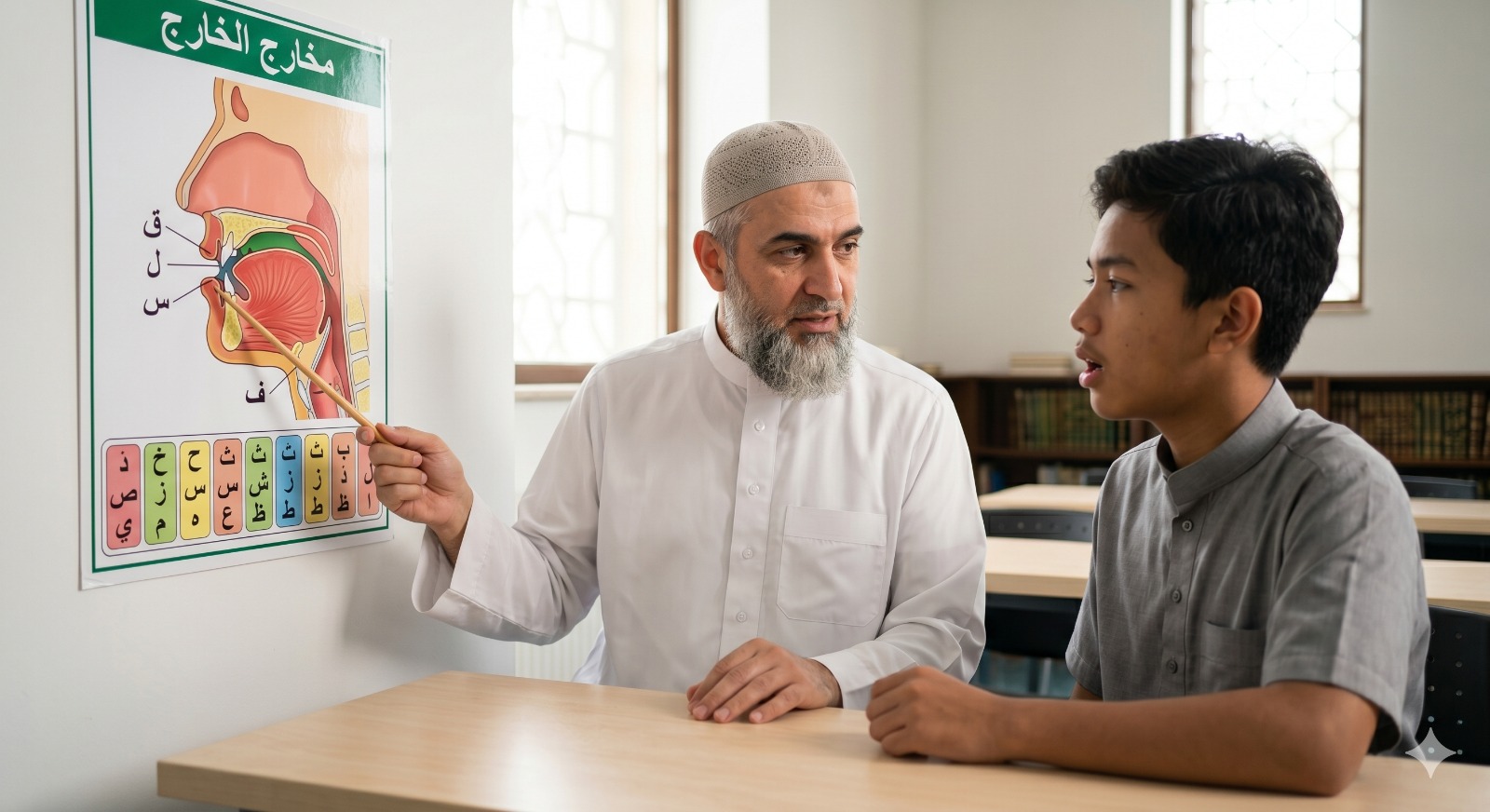
Tajweed is the set of phonetic and rhythmic rules governing the correct recitation of the Quran. The word itself comes from the Arabic root meaning “to make better” or “to improve.” It covers pronunciation of individual letters, rules of elongation (madd), rules of nasalization (ghunnah), stopping points, and how letters interact with each other in sequence.
Here is the part that surprises most beginners: tajweed is not optional. It is wajib — obligatory — according to the overwhelming majority of Islamic scholars, based on the Quranic verse commanding recitation “in slow, measured rhythmic tones” (Surah Al-Muzzammil, 73:4). Deliberate violation of tajweed rules that changes meaning constitutes a serious recitation error, called a lahn jali.
But here’s what I find equally important to say: Allah does not punish sincere effort. The Prophet Muhammad (peace be upon him) affirmed that the one who recites with difficulty earns double reward. Tajweed is a standard to strive toward, not a barrier to recitation.
The practical implication is this: learn tajweed not out of fear, but because the Quran deserves your best recitation, and your best recitation is possible with the right knowledge.
What Are the Core Rules of Tajweed Every Beginner Must Learn First?
The tajweed curriculum has a logical sequence. Most beginners make the mistake of jumping to complex rules before mastering foundational ones. I’ve seen this pattern repeatedly — students who know what ikhfa is but cannot correctly produce the letter Ain.
Start here, in this order.
Step one: Makharij al-Huruf (Points of Articulation)
This is the foundation. Every Arabic letter has a specific physical point in the mouth, throat, or nasal cavity from which it is produced. There are seventeen primary articulation points organized across five regions: the throat (halq), the tongue (lisan), the lips (shafatan), the nasal cavity (khayshum), and the oral cavity (jawf).
The letters that cause the most consistent difficulty for non-native speakers are the throat letters — Ain, Ghayn, Ha, Kha, and Hamza — and the emphatic letters (huruf mufakkhama) like Sad, Dad, Ta, and Dha. Without correctly producing these letters, no subsequent tajweed rule can be applied accurately.
Spend your first four to six weeks exclusively on makharij. Nothing else. I know that feels slow. It isn’t. Students who rush past makharij spend years correcting errors that proper foundational work prevents entirely.
Step two: Sifat al-Huruf (Characteristics of Letters)
Each letter has inherent characteristics that affect how it sounds in context. Essential characteristics include Jahr (voiced) versus Hams (whispered), Shiddah (strong) versus Rakhawah (soft), and Isti’la (elevated) versus Istifal (lowered). These characteristics explain why the letter Qaf sounds different from Kaf, and why Sad sounds different from Sin despite similar visual structure.
Understanding sifat helps you apply rules consistently rather than memorizing individual cases.
Step three: Noon Sakinah and Tanween Rules
This is where most structured tajweed courses begin with their rule-based instruction, and for good reason. Noon sakinah (a noon with a sukoon) and tanween (double vowel markings) trigger four distinct rules depending on the following letter:
Idhar (clear pronunciation) occurs before the six throat letters. Idgham (merging) occurs before six specific letters, with two sub-types: with ghunnah (nasalization) and without. Iqlab (conversion) occurs exclusively before the letter Ba, where the noon converts to a meem sound. Ikhfa (concealment) occurs before fifteen remaining letters, producing a nasalized sound between clear pronunciation and full merging.
These four rules cover a significant portion of recitation encounters in the Quran. Mastering them takes approximately six to eight weeks of consistent daily practice.
Step four: Meem Sakinah Rules
Meem sakinah triggers three rules. Idgham Shafawi occurs when meem is followed by another meem. Ikhfa Shafawi occurs before Ba. Idhar Shafawi occurs before all remaining letters. Note the labial (lip-based) nature of all three interactions — meem is a lip letter, which is why its rules cluster around other lip sounds.
Step five: Rules of Madd (Elongation)
Madd rules govern how long certain vowel sounds are held. The baseline is the natural madd — two counts (harakaat) — produced by the letters alif, waw, and ya. From there, elongation extends based on whether a hamzah or sukoon follows. The most complex, Madd Lazim, requires six counts and appears in specific Quranic contexts.
Madd rules have the greatest impact on the melodic quality of recitation. They are also among the most commonly violated rules in everyday prayer, because most people have never been told to count.
Which Tajweed Resources Actually Work? An Honest Assessment
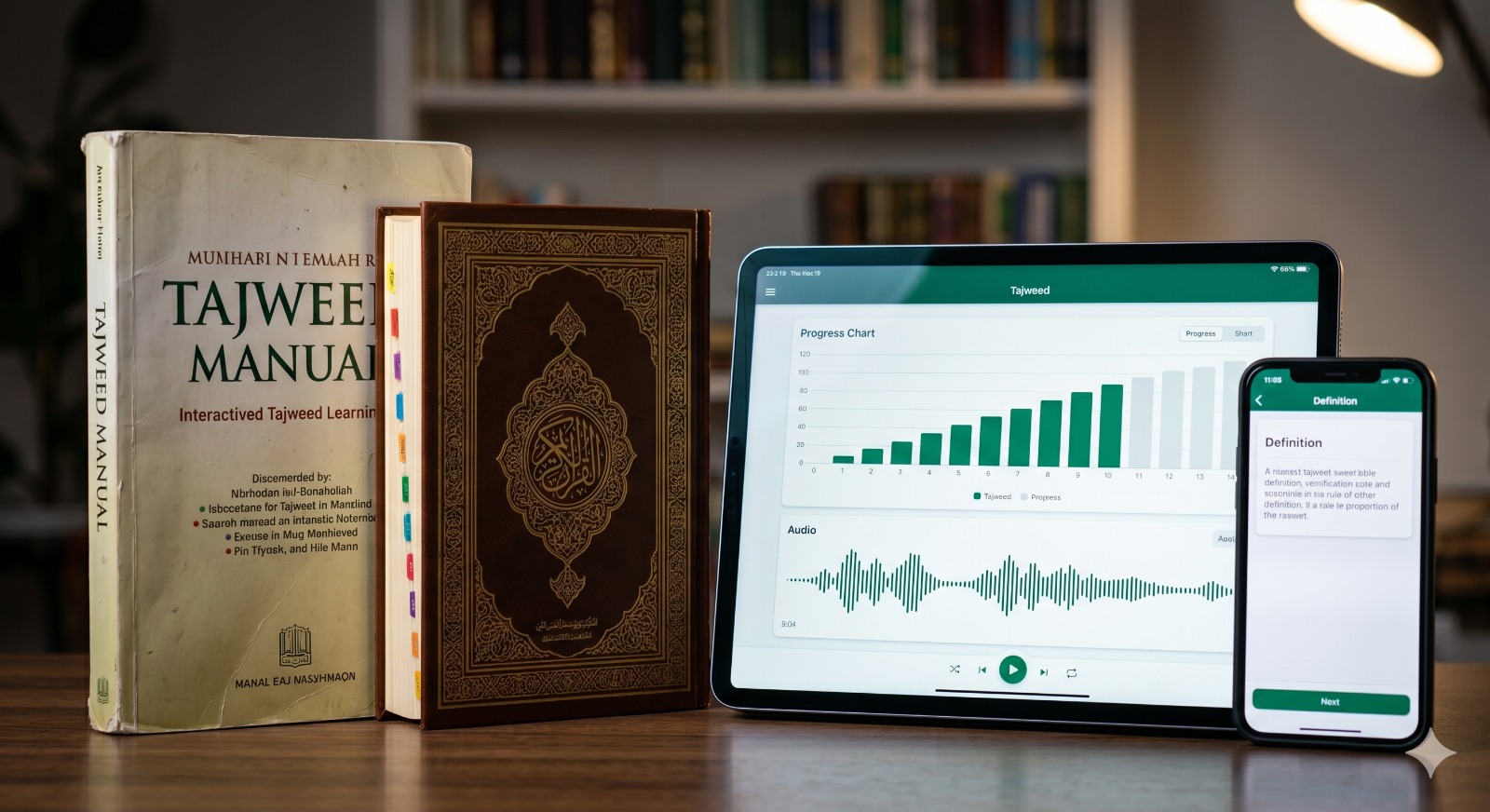
The market for tajweed learning tools has expanded significantly since 2020. Here is what I have evaluated personally and through consistent student feedback.
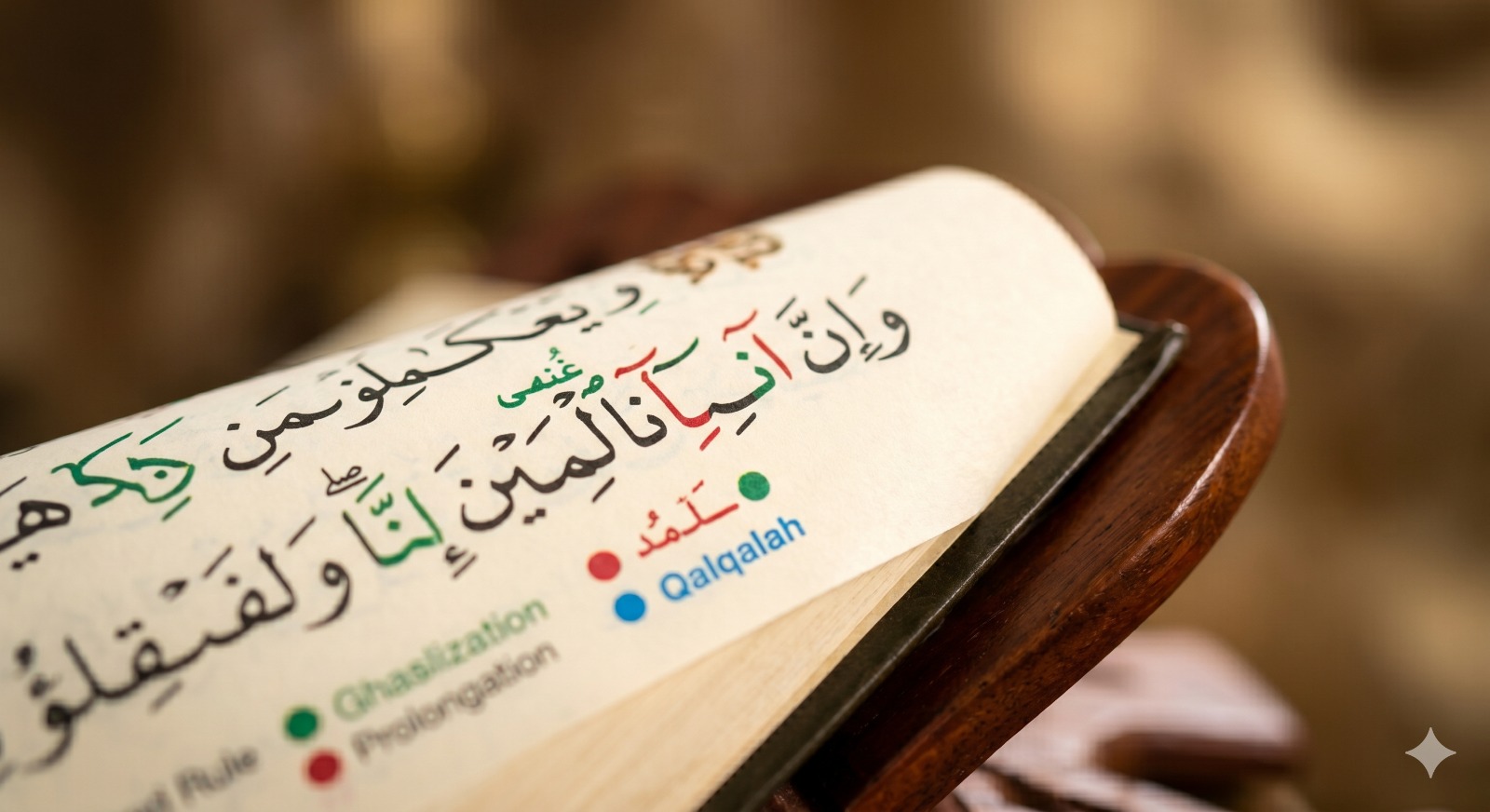
Tajweed Quran (Dar Al-Ma’arifah edition) is the physical Mushaf most widely used in structured tajweed study. Color-coding identifies different rules directly in the text. Red indicates specific letter characteristics, green marks ghunnah, and blue highlights madd. As of early 2025, it retails for approximately $15–25 depending on the size and binding. It is indispensable for visual learners and for connecting rules to actual Quranic text. Weakness: the color system requires learning before it becomes intuitive.
Tarteel AI (mentioned in our Hifz guide) functions equally well as a tajweed correction tool. It uses machine learning trained on classical recitation to identify errors in real time. At approximately $10/month, it provides instant feedback that a teacher cannot always give for every session. Important limitation: it struggles with thick regional accents and occasionally flags acceptable recitation variations as errors. Use it as a supplement, not a replacement for human correction.
Bayyinah TV offers some tajweed content within its broader Quranic Arabic curriculum. Sheikh Nouman Ali Khan’s explanations are accessible and genuinely engaging for English-speaking beginners. Monthly access costs around $11. The limitation is that it is not a structured tajweed course with sequential rule progression. Use it to understand conceptual foundations, not as primary instruction.
Mishkah Academy’s Tajweed Course costs approximately $40–60/month for live instruction with a qualified teacher. Their curriculum follows the Jazariyyah poem — a classical tajweed text authored by Ibn al-Jazari in the fourteenth century — as its structural backbone. This is how traditional tajweed has been transmitted for centuries. The advantage is proper ijazah-chain instruction. The disadvantage is that scheduling requires commitment.
Quran Teacher Live offers tajweed classes at similar price points. As noted in our assessment of online Hifz platforms, teacher quality is inconsistent. Request a specific teacher and read student reviews before committing.
Noorani Qaida deserves special mention for absolute beginners. It is not a digital product but a printed booklet (typically $3–8) that has been used for over a century to introduce children and adults to Arabic letters and basic pronunciation before formal tajweed study begins. If you cannot yet read Arabic fluently, begin here.
YouTube channels worth your time: Sheikh Ibrahim Aba Al-Khail’s channel provides some of the clearest visual demonstrations of makharij available in English. Similarly, the “Learn Tajweed” channel by Ustadha Samia Mair offers female-led instruction particularly valuable for sisters preferring female teachers. Both are free.
The Ghunnah Rule That Trips Up 90% of Beginners
Let me take a moment for a detail that competitors glossed over. Ghunnah — nasalization — is not a sound you produce. It is a resonance that occurs naturally when specific letters are held for their prescribed duration through the nasal passage. The letters noon and meem always carry inherent ghunnah of two counts when they carry a shaddah.
The error most beginners make is trying to “add” a nasal sound consciously. This produces a forced, artificial result. The correct approach is to allow the sound to sustain through the nasal cavity by not completely closing the nasal passage during pronunciation. Think of it as letting sound resonate upward rather than pushing it forward.
Testing your own ghunnah is straightforward: place two fingers gently on the bridge of your nose while producing a nasalized meem with shaddah. You should feel vibration. If you feel nothing, the ghunnah is not being produced correctly.
How Long Does It Take to Learn Tajweed Properly?
This is the question I get asked most often, and most guides avoid answering honestly. So here it is.
Basic functional tajweed — enough to recite Surah Al-Fatiha and common short surahs with acceptable accuracy — takes three to six months of consistent daily practice with a qualified teacher. “Consistent” means thirty to forty-five minutes per day, six days per week.
Comprehensive tajweed covering all rules with reliable application takes twelve to eighteen months for most adult learners. This assumes no prior formal instruction. Those with existing Arabic reading fluency progress faster. Those starting from the Arabic alphabet simultaneously should expect eighteen to twenty-four months.
Tajweed at the level required for leading prayer (imam), teaching others, or seeking ijazah requires two to four years minimum, followed by examination by a qualified examiner.
The honest confession here is that I spent my first year studying tajweed under a teacher who, I later learned, had significant gaps in her own makharij. I did not realize this until I worked with a second teacher who held ijazah from Egypt. Rebuilding those foundational habits took eight additional months. Vet your teacher’s credentials before beginning, not after.
The Five Most Common Tajweed Mistakes in Salah
Based on consistent observation across hundreds of students, these errors appear most frequently.
Mispronouncing the letter Dad is the most common single-letter error among non-Arab Muslims globally. Many learners pronounce it as a heavy Dhal or a stressed Dal. Dad is a lateral emphatic consonant — air passes along the sides of the tongue while the front makes contact with the upper molars. It requires specific tongue positioning that cannot be approximated.
Failing to elongate Al-Fatiha’s madd letters is nearly universal. In “Ar-Rahmanir Raheem,” the alif after Ra requires two full counts. Most people rush through it in half that time or less.
Skipping the ghunnah on shaddah letters in Al-Fatiha. The shaddah on the Dal in “Addeen” requires two counts of nasalization that most recitations omit entirely.
Pronouncing the letter Tha as an “S” sound. This is particularly common among South Asian, Turkish, and Southeast Asian speakers whose native languages do not contain an interdental fricative. The tongue must make light contact with the upper teeth, allowing air to escape around it.
Dropping the hamzah at the beginning of words when preceded by a vowel. This is an advanced rule called wasl, but it trips up intermediate learners who have just discovered it and then over-apply or under-apply it inconsistently.
Frequently Asked Questions About Learning Tajweed
Can I learn tajweed without a teacher using only apps and YouTube?
You can learn rules conceptually without a teacher. You cannot verify your own pronunciation without one. The human ear evaluating your specific voice, in real time, is irreplaceable in tajweed. Apps like Tarteel AI help significantly, but they do not replace a teacher who can identify why your Ain sounds like an Alif and correct the physical positioning causing the error.
Is tajweed the same across different Quran recitation styles (qira’at)?
No. The seven major qira’at — including Hafs an Asim, Warsh an Nafi, and Qalun — each have distinct recitation rules, particularly around madd lengths and specific word pronunciations. Most non-Arab Muslims study Hafs an Asim recitation. If your teacher uses a different narration, confirm this before beginning.
Do I need to understand Arabic to learn tajweed?
No. Tajweed is phonetics, not language comprehension. Many non-Arabic speakers achieve excellent tajweed. However, understanding Quranic Arabic meaning accelerates memorization and deepens the recitation experience. They are complementary, not sequential requirements.
Is tajweed different for men and women?
The rules are identical. The application differs only in volume — women in public settings apply rules at lower volume levels. Some scholars note slight natural differences in voice timbre affect the audible expression of ghunnah, but the underlying mechanics are the same.
At what age should children start learning tajweed?
Basic makharij and letter recognition can begin at age four or five. Formal rule-based tajweed instruction is most effective from age seven onward, when children can engage conceptually with rule application. Early exposure to correct pronunciation through a parent or teacher, even without explicit rule teaching, significantly advantages later formal study.
Your Tajweed Journey Starts with One Honest Assessment
The student Fatima I mentioned at the beginning of this guide? Six months after discovering her errors, she led tarawih prayer in her masjid with corrections that moved the imam to tears. She did not change her love for recitation. She refined its expression.
Tajweed is not a judgment on your past recitation. It is an invitation toward a standard that the Quran has always deserved and that you are fully capable of reaching.
Start this week with one action: find a teacher who holds ijazah and ask for a single assessment session. Do not wait for the “right time” or until you feel “ready.” The assessment is the beginning, not a prerequisite for beginning.
What aspect of tajweed has felt most confusing or inaccessible to you so far? Your answer likely points directly to where the most important work lies.