
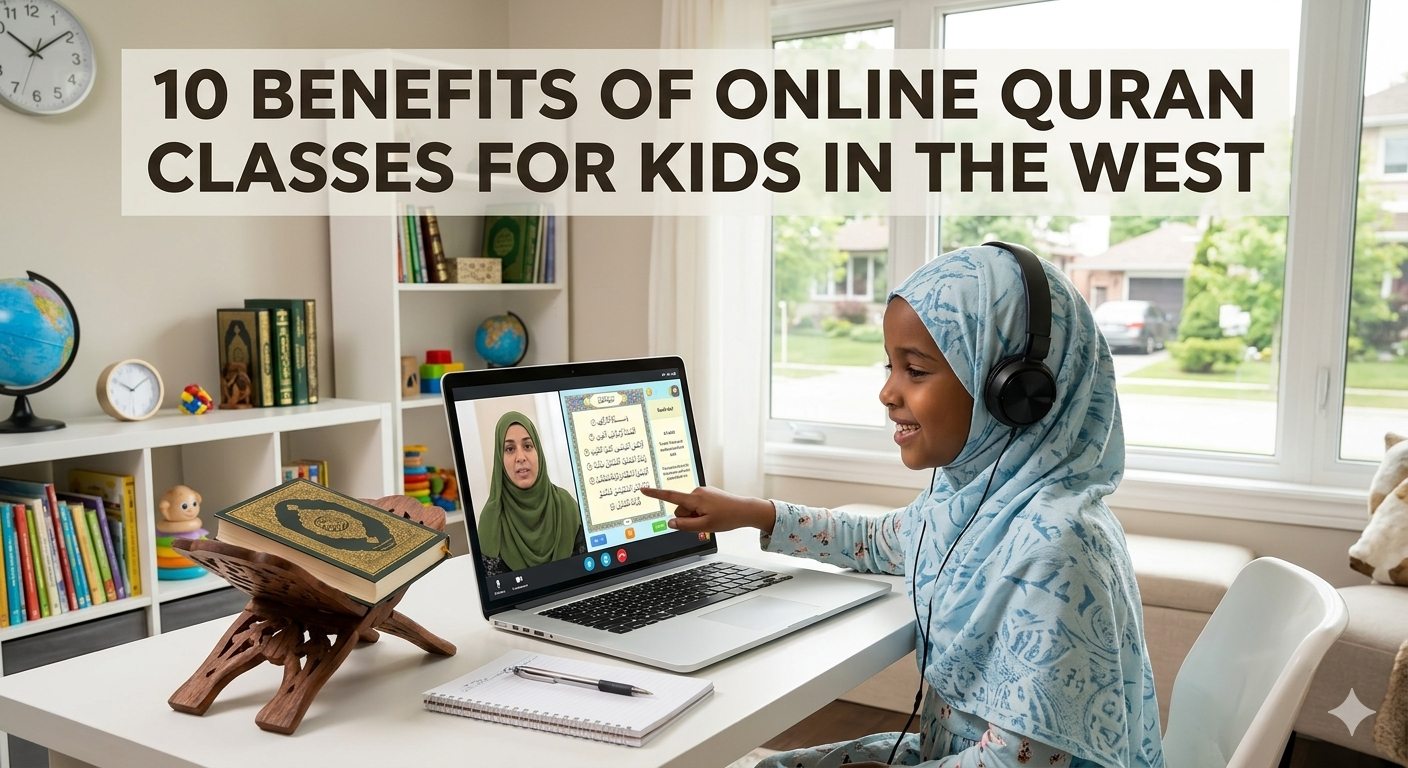
The Phone Call That Changed How I Think About Muslim Children in the West
Amira called me from Birmingham on a Tuesday afternoon in March 2023. Her son Ibrahim was eight years old, academically bright, and completely disconnected from his Islamic identity. The local masjid’s weekend Quran class had forty kids, one teacher, and no real curriculum. Ibrahim had attended for two years and could barely recognize Arabic letters.
She had tried a private tutor who cancelled sessions unpredictably. She had tried a CD-based learning program that collected dust after three weeks. She felt like she was failing her son in the most important area of his upbringing.
Six months after enrolling Ibrahim in a structured online Quran program, he was reading full Arabic sentences and reciting Surah Al-Ikhlas with correct tajweed. More importantly, he asked to do his lessons. He was not being pushed. He was pulling.
That shift from reluctant to eager is the real story of online Quran classes for kids in the West. And it is happening in living rooms across the United Kingdom, the United States, Canada, and Australia right now. This guide explains why, with the specifics that actually matter to parents making this decision.
Why Western Muslim Families Face a Unique Challenge

Before the benefits, let’s name the problem clearly. Muslim families in the West face a structural gap in Islamic education that simply does not exist in majority-Muslim countries.
In Pakistan, Egypt, or Malaysia, Quranic education is woven into the school day, the neighborhood, and the extended family. A child grows up hearing Arabic recitation constantly. Correction happens naturally. Teachers are nearby. The community reinforces what is learned at home.
In Manchester, Houston, or Melbourne, none of that ambient reinforcement exists. Parents, many of whom received their own Islamic education in different countries, in different languages, in different contexts, must deliberately construct an Islamic educational environment from scratch. They are doing this while working full-time jobs, navigating school schedules, and raising children who are simultaneously navigating two cultural identities.
Online Quran classes for kids do not solve all of this. But they solve a significant, specific part of it. Here are the ten benefits that matter most.
Benefit 1: Qualified Teachers Are Now Accessible Regardless of Location
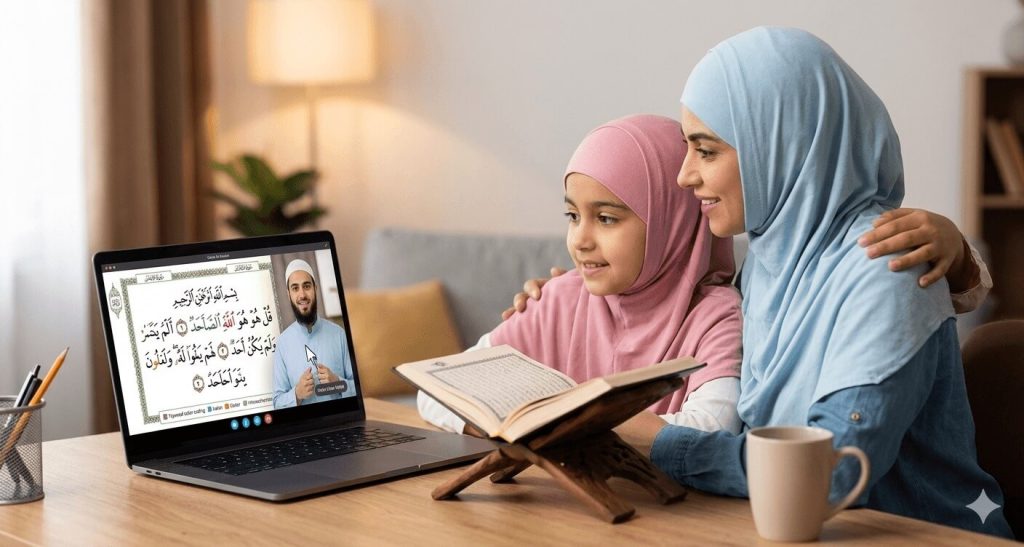
This is the benefit that changes everything. A family living in rural Alberta or suburban Ohio may have no qualified Quran teacher within an hour’s drive. Online classes eliminate that geography entirely.
Platforms like Quran Academy, Mishkah Academy, and Quran Teacher Live connect Western children with teachers who hold formal Islamic credentials like ijazah chains, tajweed certification, and years of teaching experience. The child in a small Iowa town now accesses the same quality of instruction as a child in Chicago with a large Muslim community nearby.
The qualification point matters more than most parents realize. A teacher with proper ijazah received their certification through a verified chain of transmission stretching back to the Prophet Muhammad (peace be upon him). This is not a formality. It is the difference between correct recitation being transmitted and errors being transmitted generation to generation.
When Ibrahim’s mother asked their online teacher for his credentials, he shared his complete sanad. That transparency would have been difficult to even request at the local weekend school.
Benefit 2: One-on-One Attention That Weekend Classes Cannot Provide
A typical masjid weekend class in the West has a teacher-to-student ratio of 1:15 to 1:40. That is not a learning environment. That is crowd management.
Online Quran classes almost universally offer one-on-one instruction. One child. One teacher. Thirty to forty-five minutes of undivided attention. Every error is caught. Every question is answered. Every lesson is paced to that specific child’s current level.
The developmental impact of this cannot be overstated. Children learn at radically different speeds. A child who struggles with a specific letter articulation needs ten minutes of individual correction. In a classroom of twenty, they get ten seconds, if that.
One family I know in Sydney had a seven-year-old daughter, Zainab, who struggled specifically with the Arabic letters Ain and Ghayn. These are throat letters with no equivalent in English. In a group class, her errors went unaddressed for a year. Her online teacher identified the problem in the first session and spent four consecutive weeks on makharij correction specifically for those two letters. The problem resolved. It would not have resolved in a group setting.
Benefit 3: Flexible Scheduling That Fits Real Western Family Life
Western Muslim families have school runs, extracurricular activities, work schedules, and time zone complications when extended family lives overseas. The rigid scheduling of traditional classes, like Saturday mornings and specific weekday evenings, frequently conflicts with the full reality of Western family life.
Online Quran classes offer scheduling flexibility that in-person programs structurally cannot match. Most platforms allow sessions to be booked at any available time, often including early mornings, evenings, and weekends across multiple time zones.
This flexibility directly impacts consistency. And consistency, as we covered in our Hifz guide, is the single most important variable in Quranic education outcomes. A child who attends online sessions four times per week because scheduling is easy will outperform a child who attends weekend classes twice a month because logistics are hard.
Here’s the honest caveat: flexibility can become a trap. Families who treat online sessions as optional, rescheduling whenever something “comes up,” see poor results. The flexibility is a tool for making consistency easier, not a permission slip for inconsistency. Set the schedule. Protect it.
Benefit 4: Children Learn in a Safe, Familiar Environment
This benefit is underappreciated. The learning environment matters enormously for children, particularly young children between ages five and ten.
At home, a child has no social anxiety, no unfamiliar faces, no intimidation from older students reciting confidently in front of them. They sit at their own desk, with their own Mushaf, in a space where they feel completely secure. That psychological safety accelerates learning in ways that are well-documented in educational psychology research.
A 2019 study published in the British Journal of Educational Psychology found that children in comfortable, familiar learning environments demonstrated 23% better information retention than those in novel or socially pressured settings. Tajweed rules and Arabic letter recognition require focused cognitive attention. Anxiety competes directly with that attention.
There is also a gender safety dimension that matters to many Muslim families. Girls learning Quran in a home setting, potentially with female teachers available through online platforms, resolves concerns that some families have about mixed-gender in-person classes. Platforms like Mishkah Academy maintain rosters of female teachers specifically for families who request this.
Benefit 5: Technology Tools Enhance the Learning Experience
Here’s something the traditional Islamic education world is slowly accepting: well-deployed technology genuinely improves Quranic learning outcomes for children.
Online Quran classes use tools that in-person classes cannot. Screen sharing allows teachers to highlight text in real time, point to specific letters, and display color-coded tajweed Mushafs during the session. Session recordings allow children to review their own recitation, which is one of the most powerful self-correction tools available. Parents can listen to recordings to understand their child’s progress without sitting in every session.
Supplementary apps extend learning between sessions. The Quranic app (approximately $20/month for premium) uses spaced repetition algorithms for Arabic letter recognition. Tarteel AI (approximately $10/month) provides real-time recitation error detection between formal sessions. Noorani Qaida apps offer interactive letter tracing for young children building Arabic recognition from scratch.
The result is a learning ecosystem rather than a single weekly event. Children who use two to three of these tools consistently alongside their live sessions progress significantly faster than those relying on sessions alone. You can explore our full range of interactive Quran courses designed for Western students.
Benefit 6: Consistent Progress Tracking That Parents Can Actually See
One of the most frustrating experiences parents report with traditional Quran classes is opacity: they have no clear picture of what their child has learned, what errors persist, or what the next milestone looks like.
Quality online Quran platforms address this directly. Mishkah Academy provides written progress reports after each session block. Quran Academy’s student portal tracks lessons completed, pages memorized, and teacher notes in a parent-accessible dashboard. This transparency allows parents to support learning at home, identify plateaus early, and have informed conversations with teachers about pace and methodology.
This accountability structure is something brick-and-mortar Islamic schools rarely provide, not because they don’t care, but because their resource constraints make it impractical.
For parents who are not themselves strong in Quran recitation, which describes a significant portion of Western Muslim parents who grew up with limited Islamic education, this transparency is particularly valuable. They can assess progress even without the ability to personally evaluate their child’s recitation.
Benefit 7: Cultural Identity Strengthens Through Consistent Quranic Connection
This benefit operates at a level deeper than academics, and I think it’s the most important one in the Western context.
Muslim children in the West navigate a complex identity question that children in majority-Muslim countries simply do not face. They are British or American or Canadian first in the eyes of the school, the neighborhood, and popular culture. Their Islamic identity is something they must consciously maintain against a powerful cultural current flowing in the other direction.
Consistent Quran education, not just Arabic letters, but engagement with meaning, tafsir, and the spiritual dimension of recitation, gives children an anchor. It is not decorative. It is structural.
I’ve spoken with teenage children who completed serious online Quran programs in their early years. The pattern that emerges consistently is confidence. Not arrogance, but genuine confidence in their Islamic identity that comes from competence. A thirteen-year-old who can recite with tajweed, who understands what they are reciting, who has a relationship with the Quran built through years of consistent practice, that child navigates secondary school identity pressures very differently from one who does not.
A mother in Toronto told me in late 2024 that her daughter’s online Quran education had become “the thread that connected everything else in her deen.” That phrase stayed with me. It is exactly what deliberate early Quranic education can do for Western Muslim children.
Benefit 8: Siblings Can Learn Together, Separately
This is a practical benefit that sounds small until you have multiple children and understand what it means.
In a traditional class, siblings are typically separated by age and level. One child attends on Saturday morning, another on Sunday afternoon. The family makes multiple trips. Schedules conflict. The younger child feels left behind; the older child feels held back.
Online classes allow siblings to have individual sessions scheduled back to back from the same device or simultaneously on separate devices in the same home. Each child receives instruction at their exact level, with their own teacher if needed, without either sibling being compromised by the other’s pace.
Some platforms offer family subscription pricing that reflects this use case. Quran Academy, for instance, offers multi-student discounts that bring the effective per-child cost down meaningfully for families with two or more learners.
Benefit 9: Ramadan and Summer Learning Continuity
Here is a pattern I’ve observed across many Muslim families in the West: Islamic education surges during Ramadan and drops sharply for two to three months afterward. Summer breaks the habit. School restarts. The weekend class won’t begin again until October. Three to four months of learning momentum disappears.
Online Quran classes maintain continuity across these gaps because they are not tied to institutional calendars. Sessions continue through Ramadan, often with increased frequency as families prioritize Quranic connection during the blessed month, and straight through summer without interruption.
This continuity compounds powerfully over years. A child who learns consistently for twelve months per year versus a child who stops for three to four months annually will have a measurably different Quranic foundation by age twelve. The online format simply removes the institutional interruption.
Ramadan itself deserves specific mention. Many online teachers offer special Ramadan programming including additional sessions, khatm Quran tracking, and targeted revision support that local masjid classes cannot organize at scale.
Benefit 10: It Prepares Children for a Lifetime of Independent Quranic Relationship
This is the benefit that no platform will put in its marketing copy, but it is the one I care most about.
Online Quran classes, done well, teach children how to learn. They develop self-discipline, digital communication skills, and independent study habits that transfer far beyond Quranic education. A child who manages their own online session schedule, prepares their materials, engages seriously with a teacher, and tracks their own progress is building metacognitive skills that educational researchers have identified as among the highest predictors of lifelong learning success.
More importantly, the relationship they build with the Quran through consistent, quality instruction becomes genuinely their own. It is not imposed by a teacher they barely know in a classroom they resent attending. It is built session by session, in their own space, at their own pace, with a teacher who knows their specific voice and their specific errors.
That is the foundation of a lifetime of Quranic relationship, not just childhood education.
Frequently Asked Questions About Online Quran Classes for Kids in the West
-
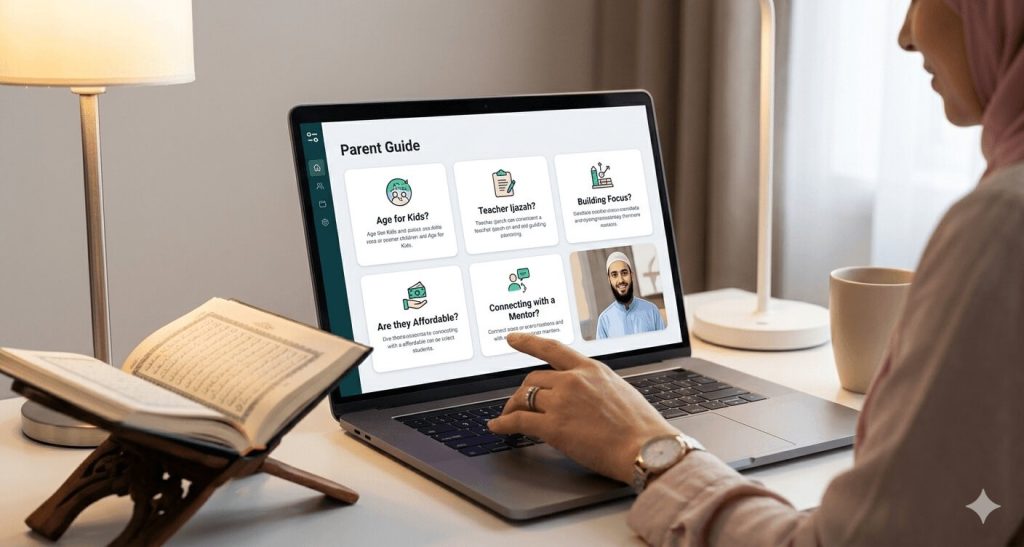
At what age should I start my child in online Quran classes? Most platforms effectively teach children from age four onward, though sessions for very young children should be short (fifteen to twenty minutes maximum) and focused on letter recognition and listening rather than formal recitation. Ages six to eight is the sweet spot for beginning structured online instruction.
-
How do I know if an online teacher is actually qualified? Ask directly for their ijazah certificate and sanad. Any teacher with genuine credentials will share this immediately. Also check whether the platform verifies teacher qualifications before listing them. Mishkah Academy and Quran Academy both conduct credential verification. Individual tutors on general freelance platforms may not.
-
What if my child loses focus during online sessions? This is the most common parent concern, and it is legitimate. The solution is session length calibration: young children should not have sessions exceeding twenty to thirty minutes. Also ensure a distraction-free space: phone notifications off, siblings not present, and a consistent “learning spot” in the home. Teachers experienced with young learners use interactive techniques specifically designed to maintain attention through short screens.
-
Are online Quran classes cheaper than in-person alternatives? Generally yes. Quality online programs range from $35–80/month. Full-time Islamic schools in the West cost $3,000–8,000/year. Part-time masjid programs are often cheaper but deliver significantly less individual instruction per hour invested.
-
Will my child build a real connection with an online teacher? This surprises many parents, but yes, strongly. Children often develop deeper relationships with online Quran teachers than with group-class teachers precisely because the one-on-one format means the teacher actually knows them. I have spoken with children who have maintained the same online Quran teacher for four or five years and consider that teacher among their most significant mentors.
The Real Question for Western Muslim Parents
Every benefit in this guide points toward the same underlying truth: online Quran classes for kids in the West are not a compromise or a consolation prize for families who cannot access “real” instruction. They are, for most Western Muslim families in 2025, the best available option for serious, sustained, quality Quranic education.
The structural advantages of qualified teachers, individual attention, flexible scheduling, progress transparency, and learning continuity address the specific challenges Western Muslim families actually face. Not theoretically. Practically.
Ibrahim in Birmingham can now recite Surah Al-Fatiha with correct tajweed. He can read Arabic. He has a teacher who knows his voice and his weaknesses and his progress over fourteen months. He is eight years old and he asks to do his Quran lesson.
That is not a small thing. For his mother, it is everything.
What is the biggest barrier your family faces in finding consistent Quranic education for your children? I’d like to understand what’s actually holding families back, because the solutions may be simpler than you realize.